
- All Post
- Agriculture
- Beauty
- Crop Insurance
- Cultivation
- Finance
- Fire Safety
- Land Measurement in India
- Lifestyle
- News
- Photography
- Services
- Tools
- Travel
- Vastu Shastra
- Wellness
- कृषि और बागवानी

Child development is a continuous journey where children grow physically, emotionally, socially, and intellectually. Understanding the stages of child development helps parents, teachers, and caregivers nurture children effectively. Each stage has unique characteristics, milestones, and challenges.
In this article, we’ll explore the five major stages of child development and their key traits.
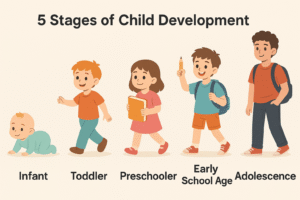
Key Characteristics:
Rapid physical growth (height, weight, motor skills).
Development of sensory abilities (touch, vision, hearing).
Bonding with parents/caregivers (attachment).
First words and basic communication skills.
Emotional expressions like smiling, crying, fear, or excitement.
👉 Parent Tip: Provide a safe environment, lots of affection, and sensory stimulation.
Key Characteristics:
Development of language and vocabulary.
Improved motor skills (running, climbing, drawing).
Beginning of social interactions and friendships.
Strong imagination and creativity (pretend play).
Early sense of independence but still needs guidance.
👉 Parent Tip: Encourage play-based learning, storytelling, and social interaction.
Key Characteristics:
Growth slows compared to earlier years.
Increased focus on academics and learning.
Logical thinking and problem-solving improve.
Peer groups and friendships become important.
Sense of responsibility and self-discipline starts to develop.
👉 Parent Tip: Support schoolwork, encourage hobbies, and guide emotional growth.
Key Characteristics:
Puberty leads to rapid physical and hormonal changes.
Identity formation and independence seeking.
Critical thinking and abstract reasoning abilities improve.
Strong peer influence and social relationships.
Emotional fluctuations due to hormonal changes.
👉 Parent Tip: Offer emotional support, open communication, and guidance on decision-making.
Key Characteristics:
Transition from dependence to independence.
Development of personal identity and career goals.
Formation of long-term relationships.
Increased responsibility and self-reliance.
Emotional maturity continues to grow.
Parent Tip: Encourage independence while providing emotional and moral support.
Understanding the stages of child development helps parents and educators provide the right support at the right time. Each stage is unique and contributes to the overall growth of a child into a well-rounded adult.
By observing these stages and recognizing their characteristics, you can ensure your child’s healthy development and lifelong success.
{ "@context": "https://schema.org", "@type": "FAQPage", "mainEntity": [ { "@type": "Question", "name": "What are the main stages of child development?", "acceptedAnswer": { "@type": "Answer", "text": "The main stages of child development are: Infancy (0–2 years), Early Childhood (2–6 years), Middle Childhood (6–12 years), Adolescence (12–18 years), and Young Adulthood (18–21 years)." } }, { "@type": "Question", "name": "What are the characteristics of infancy?", "acceptedAnswer": { "@type": "Answer", "text": "Infancy (0–2 years) is marked by rapid physical growth, development of sensory and motor skills, emotional bonding with caregivers, first words, and early communication skills." } }, { "@type": "Question", "name": "What are the characteristics of early childhood?", "acceptedAnswer": { "@type": "Answer", "text": "Early childhood (2–6 years) is characterized by language development, improved motor skills, imagination and creativity, social interactions, and the beginning of independence." } }, { "@type": "Question", "name": "What happens during middle childhood?", "acceptedAnswer": { "@type": "Answer", "text": "Middle childhood (6–12 years) includes slower growth, focus on academics, improved logical thinking, peer group importance, and a growing sense of responsibility and self-discipline." } }, { "@type": "Question", "name": "What are the main changes in adolescence?", "acceptedAnswer": { "@type": "Answer", "text": "Adolescence (12–18 years) is marked by puberty, identity formation, abstract thinking, emotional fluctuations, and a strong influence of peers and social relationships." } }, { "@type": "Question", "name": "What are the key characteristics of young adulthood?", "acceptedAnswer": { "@type": "Answer", "text": "Young adulthood (18–21 years) is the stage of independence, career focus, long-term relationships, emotional maturity, and self-reliance." } } ] }